
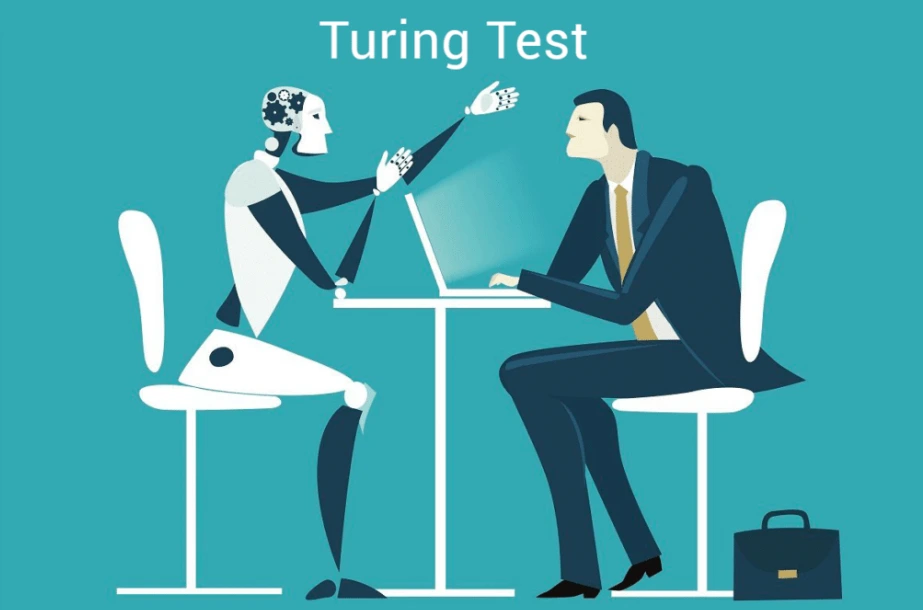
What is Turing test?
The Turing Test is a test of a machine’s ability to exhibit intelligent behavior indistinguishable from a human during natural language conversations. It was proposed by British mathematician and computer scientist Alan Turing in 1950 and is named after him. The test involves a human evaluator who engages in text-based conversations with both humans and machines. It tries to determine which is which based on the responses they receive.
Important factors and components of the Turing Test include:
- Natural Language Understanding: The machine must have the ability to understand and generate human language responses effectively. This includes not only parsing and processing text but also grasping the context and nuances of the conversation.
- Natural Language Generation: The machine should be able to produce responses that are coherent, contextually relevant, and grammatically correct. It should be capable of forming meaningful and engaging conversations.
- Contextual Understanding: The machine must maintain context throughout the conversation. It responds appropriately to the human evaluator’s questions, prompts, and statements.
- Human-like Behavior: The machine should mimic human behavior, including the use of humor, empathy, and social cues when appropriate. It should avoid making responses that would reveal its non-human nature.
- Versatility: The machine should be able to engage in various topics and adapt to different conversation styles.
- Passing the Evaluator’s Judgment: The ultimate goal is for the machine to pass the judgment of a human evaluator. Unaware of which entity (machine or human) they are interacting with. If the evaluator cannot consistently distinguish between the engine and human responses, the device is said to have passed the test.
- Subjectivity: The Turing Test acknowledges that the evaluation can be subjective, as different human evaluators may have varying levels of expertise and expectations. Some may be more forgiving or critical in their assessments.
- Turing’s Imitation Game: Alan Turing originally presented the idea of the Turing Test as an “imitation game,” where the machine’s goal is not to demonstrate true understanding or consciousness but to imitate human conversation to such an extent that it confuses the evaluator.
It’s important to note that while the Turing Test is a classic benchmark for evaluating machine intelligence and natural language processing capabilities. It has its limitations and has been subject to criticism. Passing the Turing Test does not necessarily mean a machine possesses genuine understanding, consciousness, or intelligence. It only measures its ability to simulate human-like conversation. Nonetheless, it has played a significant role in the history of artificial intelligence and remains a point of reference for assessing AI capabilities in natural language interaction.


